
Executive Committee
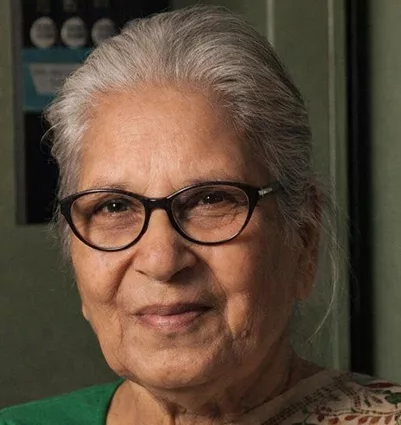
Pratibha Agrawal
Pratibha Agrawal
Dr Pratibha Agrawal is the prime mover of NATYA SHODH SANSTHAN. She is not only one of the founders of the organisation but also the moving spirit behind the initiation, development, and continuation of the institution.
While putting up an exhibition of the playwright Bharatendu Harishchandra, Agrawal realised the importance of having an archive that would help in collating materials and saving information for posterity, and the seeds of the Sansthan were sown.
Hailing from the family of Bharatendu Harishchandra, theatre was in her genes. Apart from carrying on with her academic pursuits, she has been an actor, a playwright, a director, and the founder of the famous theatre group Anamika, whose productions ran to full houses in Calcutta and elsewhere.
So, when the Santhan was founded in 1981, she could easily forge relationships with all the eminent theatre personalities of the country. They came forward generously with their materials for the archives and invaluable intellectual contributions and participated in several programmes, seminars, and talks.
Sansthan gradually built its pan-Indian image.
With an MA in Hindi and a PhD, Dr Pratibha Agrawal stepped into the world of teaching. She was the Head of the Department of Hindi and then Vice Principal and Principal of Shree Shikshayatan College, Kolkata. For her significant research on Hindi muhavara, she got a D.Litt.
Agrawal has authored and translated many books and plays.
To immortalise the memories of her late husband, Madan Mohan Agrawal, who had always been a source of inspiration for her, she founded the Upchar Trust in 1980, which had a meaningful role to play in the foundation of NATYA SHODH SANSTHAN.
For her contributions to performing arts and literature, several awards were conferred on her—the Sangeet Natak Akademi award, the Uttar Pradesh Hindi Sansthan Puraskar for her translation works, the Madhya Pradesh Sahitya Parishad Puraskar, the Bharatiya Anuvad Parishad Puraskar, and an award from the Sahitya Akademi.
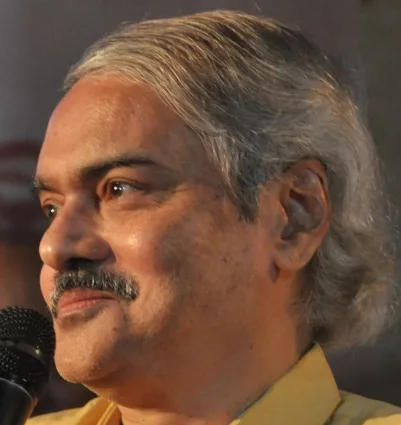
Ananda Lal
Ananda Lal
Prof. Ananda Lal learnt theatre hands-on with the Kolkata group, The Red Curtain (1973-80), did a Ph.D. in Theatre from the University of Illinois in 1986, and has been a regular at NSS since then. He taught drama in the Comparative Literature and English Departments at Jadavpur University, retiring in 2017. He introduced a practical theatre course there in which he directed students for public performances every year for 25 years. His project to establish in Jadavpur University a Tagore Cultural Complex with four separate theatre spaces won prestigious Ministry of Culture funding from the Government of India but has still not materialised.
As theatre critic of The Telegraph (1986-2018) and The Times of India (2018-20), he reviewed more than 3,000 productions, continuing to do so now on his website KolkataTheatre.com. His most important books on theatre include, in order of publication, Rabindranath Tagore: Three Plays, Rasa: The Indian Performing Arts, Shakespeare on the Calcutta Stage, The Oxford Companion to Indian Theatre, Twist in the Folktale: Three Plays, Theatres of India, Indian Drama in English: The Beginnings, Utpal Dutt: Barricade, and Centrestage: Essays on Theatre, Indian and Intercultural. He directed over 30 theatre productions and worked on many others, especially such international successes as Shakespeare’s Midsummer Night’s Dream (directed by Tim Supple), for which he did the dramaturgy, and lectured widely abroad and at home on Indian theatre. He has written several teleplays, including the nine-episode Two Hundred Years of Bengali Theatre for Doordarshan.
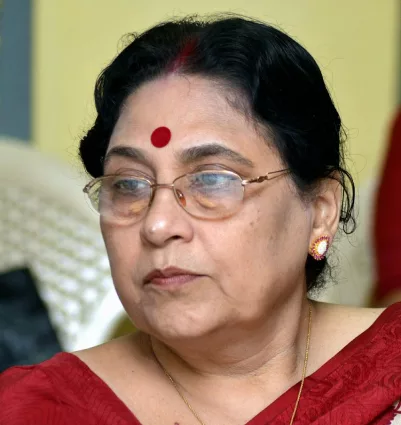
Basabi Roy
Basabi Roy
Dr Basabi Roy is widely known in the academic and performing arts circles as a connoisseur of sorts. Once heading the Department of Bengali in Jadavpur University, Basabi Roy has continued to explore her interest in theatre and Bengali literature through multiple publications on varied subjects. Her seminal work on Khirode Prasad Bidyabinod is a must-read for scholars working on 19th-century drama and theatre. Her other publications include books on Mohit Chattopadhyay and Manoj Mitra.
As the Vice President of NATYA SHODH SANSTHAN, she remains an important resource person to guide students and scholars visiting the Sansthan library. She has been the convenor of several seminars organised by Sansthan and plays a positive role in framing policies for NATYA SHODH SANSTHAN.
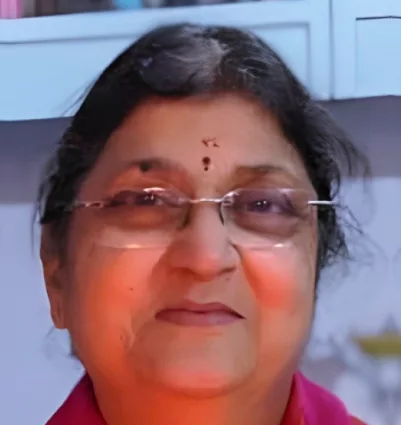
Yama Shroff
Yama Shroff
Yama Shroff was instrumental in conceptualising the very idea of the NATYA SHODH SANSTHAN (NSS) and has been one of its Core Committee members since inception. She has served as Secretary to the Executive Committee of NSS from 1981 to the present. Under her aegis, the audio archive developed into a significant and valuable repository.
A graduate of the University of Calcutta, she also completed a certificate course in silk screen printing at the Corcoran Art Gallery, Washington DC, USA. She is a trained Indian classical music vocalist, having studied rigorously under Pandit A.T. Kanan and Malavika Kanan, and learnt Bharatanatyam from Manjulika Ray Chowdhury.
She has had the opportunity to work with several renowned directors of Indian theatre, including Shyamanand Jalan, Shiv Kumar Joshi, Sheo Kumar Jhunjhunwala, Bimal Lath, Rajindar Nath, Satyadev Dubey, Amol Palekar, Swaran Chowdhury, Tripti Mitra, Usha Ganguli, and Sohag Sen, among others.
An accomplished performer for over six decades, she began her acting career in 1962. Her repertoire includes a wide range of plays such as Sheshraksha, Chhalava, Kaanchanrang, Saari Raat, Abu Hossein, Pagla Ghora, Evam Indrajit, Kamla, Laxman Rekha, Steel Frame, Ek Aur Dronacharya, Aadhe Adhure, Raajdarshan, Reshmi Rumal, Rudali, The Unexpected Guest, Sonata, and many others. She has been associated with prominent theatre groups, including Anamika, Rangakarmee, Proscenium, and Ensemble. In addition to acting, she has also worked as a costume designer for several productions, notably Chandragupta and Antigone.
Her work extends to television and film as well. She has performed in television serials directed by Amol Palekar and Kalpana Lajmi and appeared in feature films such as 15 Park Avenue (dir. Aparna Sen) and Woh (dir. Buddhadeb Dasgupta). She has also participated in various light music programmes.
In addition, she has translated several plays into Hindi from Bengali and English, as well as scripts for television serials, films, and short stories.
She served as Secretary of the theatre group Anamika during two tenures: 1979–1981 and 1992–1996.

Gyaneshwar Prasad Agrawal

Madhuchhanda Chatterjee
Madhuchhanda Chatterjee
Dr Madhuchhanda Chatterjee was a faculty member in the Department of English at Rabindra Bharati University, Kolkata. She has authored multiple publications on theatre and literature, which include “Rasa”: Anthology of Performing Arts (2 vols.), Shyamanand Jalan: A Pictorial Tribute, Girish Karnad: In Quest, and Farce and Farceurs, and she edited Panchatantra Tales and Bhagvad Gita (with notes and interpretations).
She has curated the Theatre Museum of NATYA SHODH SANSTHAN and worked extensively in the social development sector. With expertise in arts and culture, she has been a consultant to the Ministry of Culture, Government of India, for Rabindranath Tagore’s 150th birth anniversary and served as the nodal officer for a digitisation project of the Indira Gandhi Centre for the Arts, Government of India. She is the Executive Director of Anamika Kala Sangam, Kolkata, and serves on its editorial board.
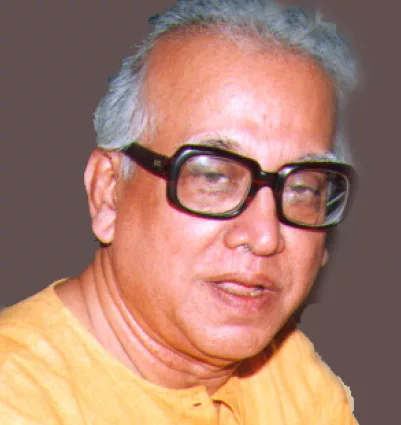
Pabitra Sarkar
Pabitra Sarkar
Pabitra Sarkar is a distinguished linguist, literary critic, educator, theatre practitioner, children’s writer, and singer of Rabindra Sangeet, with three CDs to his credit. Born in 1937 in a village near Dhaka and displaced by Partition in 1947, he studied Bengali language and literature and topped the list of successful candidates both in his Bachelor of Arts (Honours) and Master of Arts examinations from the University of Calcutta, with a First Class in the latter. He taught at Bangabasi College, Kolkata, and Jadavpur University, Kolkata, rising to Professor, and later served as Vice-Chancellor of Rabindra Bharati University, Kolkata (1990–1997). A Fulbright scholar, he earned an MA and PhD in linguistics from the University of Chicago and taught in the United States. Deeply involved in theatre as an actor and critic, he has also authored 86 books and edited over 100, with a special love for children’s literature. His numerous honours include the Vidyasagar Award, the Indira Gandhi Award, and Japan’s Order of the Rising Sun. Still active, he continues teaching, writing, and travelling widely.
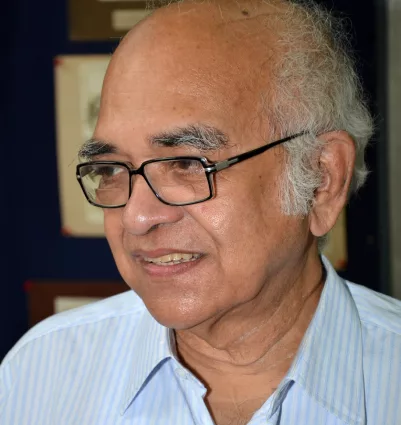
Samik Bandyopadhyay
Samik Bandyopadhyay
Samik Bandyopadhyay—scholar, theatre, film and art critic, teacher, and writer, as well as a specialist in theatre—played a pivotal role in NATYA SHODH SANSTHAN (NSS) with his invaluable advice and guidance. Bandyopadhyay graduated with an honours degree and an MA in English Literature from Presidency College, Kolkata, and the University of Calcutta, respectively. He began his career as a lecturer at Rabindra Bharati University and later joined Oxford University Press, Kolkata, as regional editor. He was also one of the founding members of Seagull Books, Kolkata. He served as a member of the Publication Committee of the Sangeet Natak Akademi, New Delhi, and held several distinguished academic and administrative positions, including ICCR Chair at the Department of Theatre Studies; Visiting Professor at the Freie Universität, Berlin; Vice-Chairman of the National School of Drama; and Member of the National School of Drama Society. He has also been a Rabindranath Tagore National Fellow at the School of Arts and Aesthetics, Jawaharlal Nehru University, New Delhi.
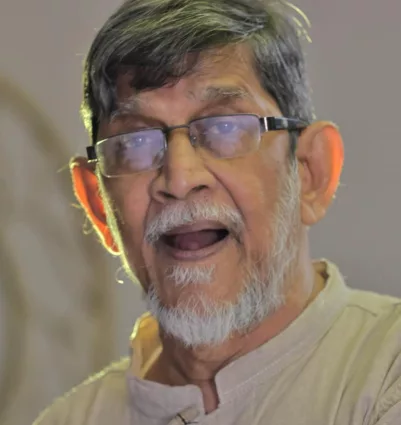
Debasis Majumdar
Debasis Majumdar
Debasis Majumdar is a renowned Bengali playwright. He was associated with the Theatre Commune for six years (1971-1977). He acted in the play Parabarti Biman Akraman (The Subsequent Air Raid). However, he never considered acting his primary field. He was in charge of the stage design for the plays Parabarti Biman Akraman, Swadeshi Naksha, King King, and Dansagar. Later, he left Theatre Commune and founded the independent theatre group Sudrak (1977). He has written numerous plays, including Amitakshar, Samabartan, Ishavasya, Asamapta, Swapnasantati, Rangamati, and Chandalini. He also wrote two plays, Bithan and Basana, for the Natyaranga group. Among his notable short plays are Imankalyan, Dinkal, Pratimar Kal, Pakhiwala, and Asamay. Except for Chandalini, all of his plays were translated into Hindi. While Dansagar was also translated into Kannada, Amitakshar has been translated into English, Odia, Marathi, Tamil, Kannada, and Punjabi. He is the editor of Sudrak, an annual theatre journal on theatre. His notable awards include the Girish Puraskar (1978), Paschimbanga Nritya-Natya-Sangeet o Charukala Academy Puraskar (1983), Satyendra Mitra Puraskar (1993), Nandikar Samman (1995), Anya Theatre Samman (2003), Paschimbanga Natya Academy Puraskar (2004), and Sangeet Natak Akademi Award (2005).
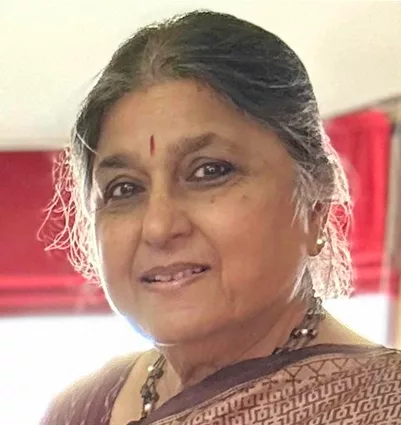
Divya Jalan
Divya Jalan
Dr Divya Jalan is an educationist with a special interest in the development of children with disabilities and economic disadvantages, especially in the early childhood years. She is particularly interested in ensuring that research-based evidence is translated into best practices. She is committed to working towards strengthening organisation cultures to follow principle- and governance-based actions.
As one of the founder members of Action for Ability Development and Inclusion (AADI), Divya Jalan has been a pioneer in setting up an institution advocating for the interests of people with disabilities. Today, AADI is a leader in the country with a rights-based approach and a focus on inclusive practices in schools, workplaces and the community in general. AADI, which focuses on building the capacity of professionals and institutions in the country, works extensively on bringing national-level legislative and policy changes.
Through the Goodearth Foundation, her focus has been to work with educational thinkers and teachers in rural schools in Maharashtra and Rajasthan, run by NGOs or local government, with the goal of improving the quality of teaching and learning in these schools.
As a trustee of Pratham, Delhi, she is part of a group that develops strategies for the education of pre-school and young children with economic disadvantages in the city of Delhi.
She has been a member of the State Advisory Council and the Curriculum Reform Committee, constituted by the Government of Delhi in 2018 and 2020, respectively. She was part of a core group working towards curricular reform and improving initiatives for inclusive education in Delhi schools.
Her current work has evolved from her vast experience in the education of children with disabilities and those with economic disadvantages in rural and urban schools in India. Her work experience with the Head Start programme as well as with emotionally disturbed adolescents in the USA, and her study experience in the English school system, have deepened her understanding of general themes as well as culture-influenced issues in child development.
Divya Jalan has a bachelor’s degree in Education (Hons.) from the University of Calcutta. Further, she got a diploma in teaching physically disabled children and a master’s in early childhood education, both from the University of London. Her doctoral research at SNDT University, Mumbai, was based on her work on introducing reflective practices as a tool for skill improvement and empowerment of teachers in government schools in rural areas of Maharashtra.
Pramod Shroff
Suranjana Dasgupta
Suranjana Dasgupta
Suranjana Dasgupta, born in October 1963, is a prominent theatre practitioner associated with Bengali Group Theatre since 1980. She has worked with over twenty theatre groups across West Bengal, including Theatre Workshop, Chetana, Purba Paschim, Rangkarmi, and Naihati Bratyajan, and collaborated with eminent directors such as Utpal Dutta, Soumitra Chattopadhyay, Usha Ganguly, and Suman Mukhopadhyay. Acclaimed from the outset as a singer-actor, she received a special award from Paschimbanga Natya Akademi in 1988 for her performances in Madhav-Malanchi Koinya and Sadhabar Ekadashi. She is currently the director and actor of her own group, Nirbak Abhinay Academy. An A-grade drama voice at Akashvani, Kolkata, she also serves as a guest examiner at the National School of Drama and Rabindra Bharati University. Her recent honours include awards from Nandipat (2022), Purba-Paschim, and Anya Theatre (2025). She is nationally recognised as an actor, playwright, director, trainer, and advocate of women-centric theatrical expression.
Arvind Agrawal
Arvind Agrawal
Arvind Agrawal graduated in Commerce from the University of Calcutta in 1985 and obtained his law degree in 1989, enrolling with the Bar Council of West Bengal in 1990. He specialises in direct tax advisory and litigation, practising before the Calcutta High Court and the Income Tax Appellate Tribunal, and serves as the Managing Partner of M/s. G.P. Agrawal & Associates. He has held leadership roles in professional bodies and is actively associated with the Merchants’ Chamber of Commerce & Industry, where he serves as the Chairman of the Direct Taxes Standing Council; the Bengal National Chamber of Commerce & Industry; the Indian Chamber of Commerce; and the Bharat Chamber of Commerce. He served as the President of the Rotary Club of Calcutta Victoria on two occasions, during the years 2016–17 and 2023–24.
Agrawal hails from a distinguished lineage tracing its roots to Alsisar village in the Jhunjhunu district of Rajasthan and to Maharaj Agrasen. A third-generation professional, he was born into a highly educated family. His grandfather, the late Bhuramal Agrawal, was an eminent advocate of the Supreme Court of India and the Calcutta High Court and was honoured by the Queen of England. His father, the late Gobind Prasad Agrawal, FCA, founded the chartered accountancy firm M/s. G.P. Agrawal & Co. in 1954.
He remains deeply engaged in social service and contributes to Indian theatre scholarship through NATYA SHODH SANSTHAN.
Kishore Krishna Banerjee
Kishore Krishna Banerjee
Kishore Krishna Banerjee, popularly known as K.K. Banerjee in the professional arena, has served under the Ministry of Commerce, the Ministry of Culture and Prasar Bharati under the Ministry of Information and Broadcasting, Government of India, and retired as the Director General of the Raja Rammohun Roy Library Foundation & Mission Director of the National Mission on Libraries. During his tenure, he also held the additional charges of Director General of the National Library of India and Secretary-Curator of Victoria Memorial Hall, Kolkata. He was also the adviser to the National Mission on Libraries, a project of the Government of India, and Project Director (Archives) East and Northeast Zone of Prasar Bharati, Kolkata. He was associated with a number of committees constituted by the Government of India for strengthening library services in the country. While at the Ministry of Culture, Government of India, he led the cultural exchange programme between India and Bangladesh in the celebration of Tagore’s 150th birth anniversary celebrations.
Besides these official activities, he has contributed a number of articles to professional journals and has translated several short stories of eminent writers from Hindi into Bengali and is also actively associated with a little magazine, Ebang Jalarka. After doing his master’s at Jadavpur University, he obtained the bachelor’s degree of Library and Information Science from Rabindra Bharati University, Kolkata. Presently, he is working on a topic, ‘Intelligentsia and Public Libraries in the 19th Century Bengal’, which involves a study on a varied and wide spectrum of public libraries located in the country and abroad.

Suvro Mazumdar
Suvro Mazumdar
Dr Suvro Mazumder is a theatre research scholar, critic, and audio-visual digital archivist with over two decades of engagement in theatre and performance studies.
He began his professional career with BanglaNatak.com in 2000 and subsequently joined NATYA SHODH SANSTHAN as a Research Scholar, where he was involved in several significant research projects in theatre. A number of these projects have been published as books. He was later inducted into the institution’s Executive Committee at the initiative of its founder-director, Dr. Pratibha Agrawal.
Between 1995 and 2022, he was actively engaged as a drama critic, contributing to various newspapers, theatre journals, and edited volumes. His scholarly and critical work has been recognized with several honours.
He currently works as an Audio-Visual Digital Archivist, with a focus on the in-house digitization, restoration, and preservation of archival materials, contributing to their long-term accessibility for research and documentation.